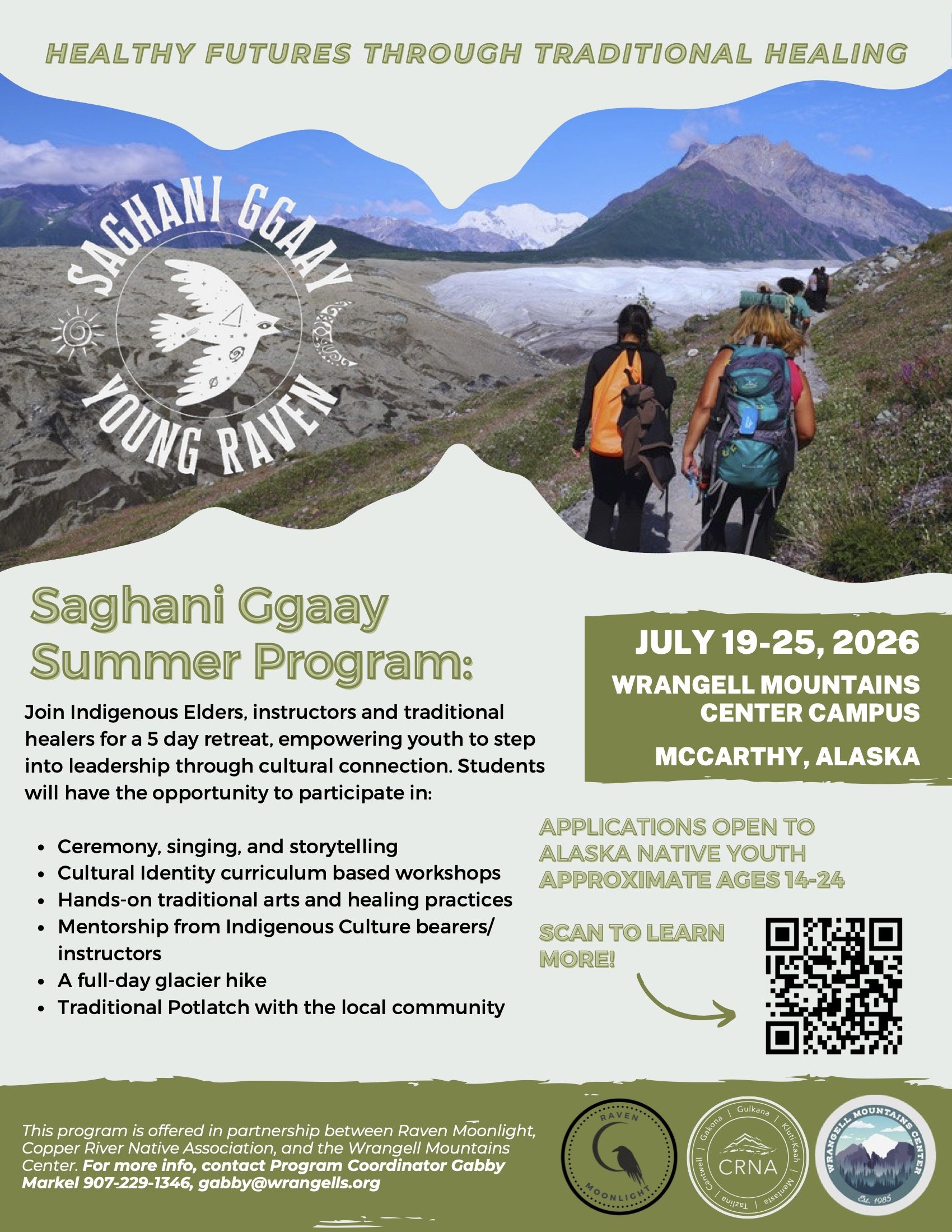
Saghani Ggaay (Young Raven)
Alaska Native Youth Summer Program

July 19-25, 2026
Wrangell Mountains Center Campus
McCarthy, Alaska
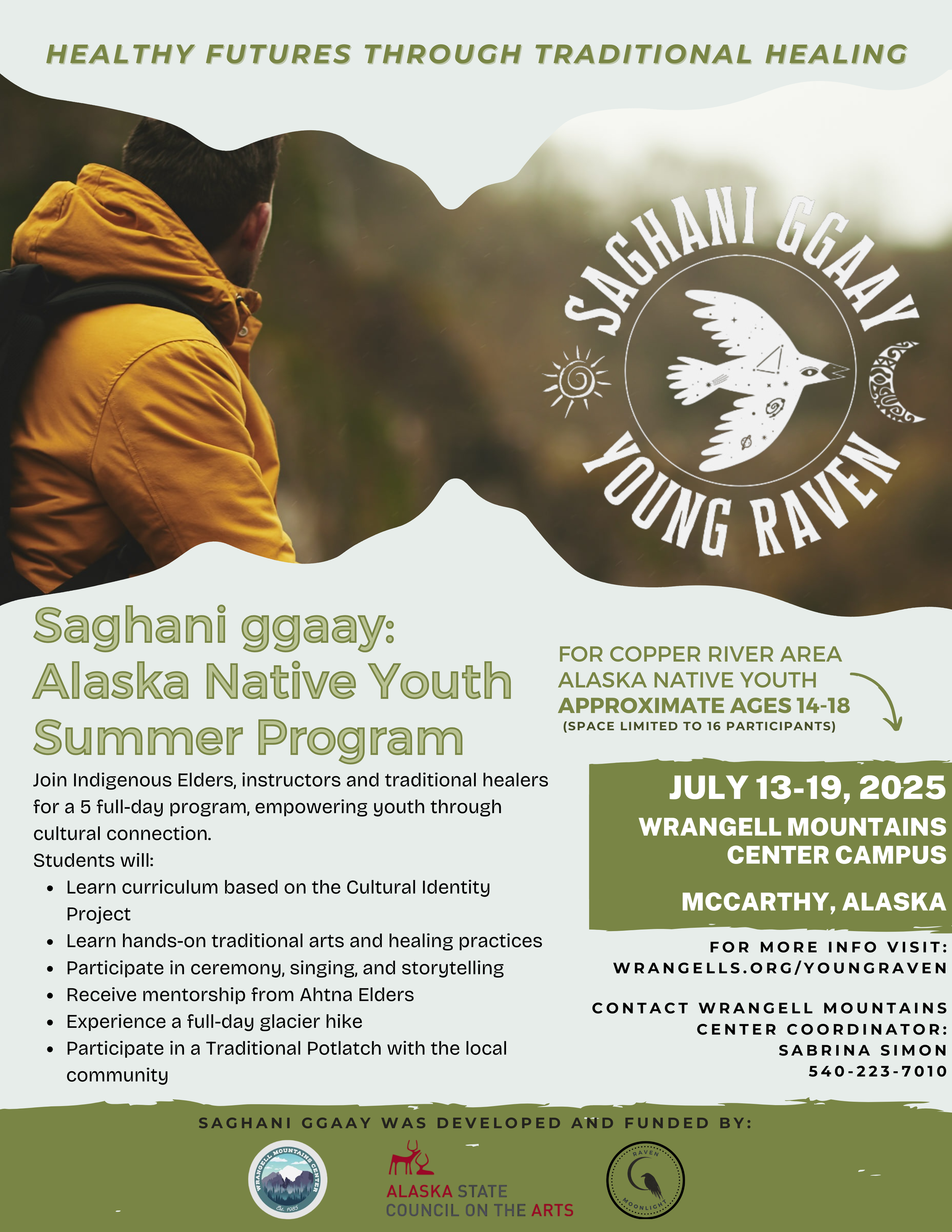
Saghani Ggaay is a healing retreat grounded in culture and identity. The program’s aim is to empower Alaska Native youth through cultural connection, reconnection with the land and strengthening of community relationships.
Overview
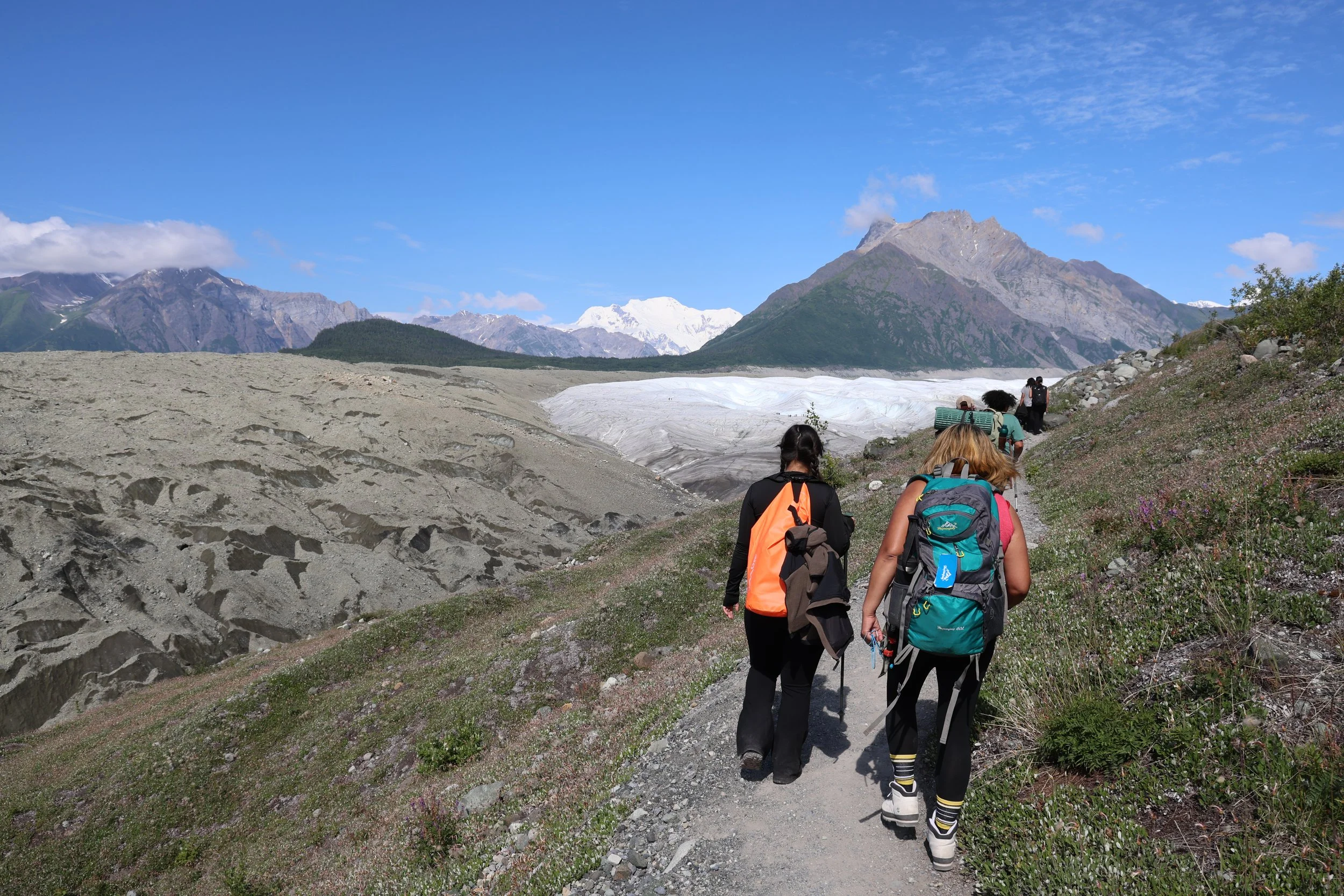
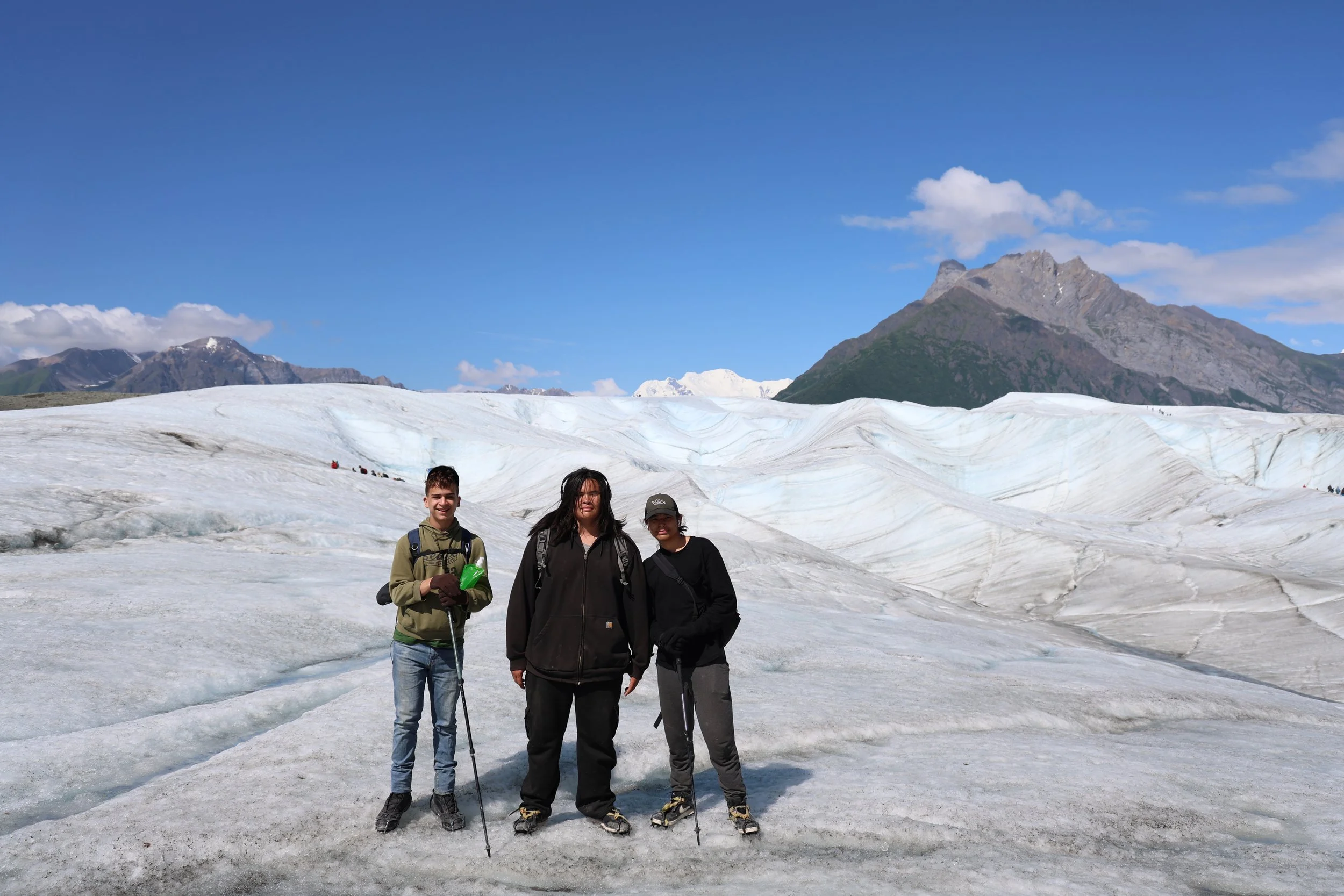
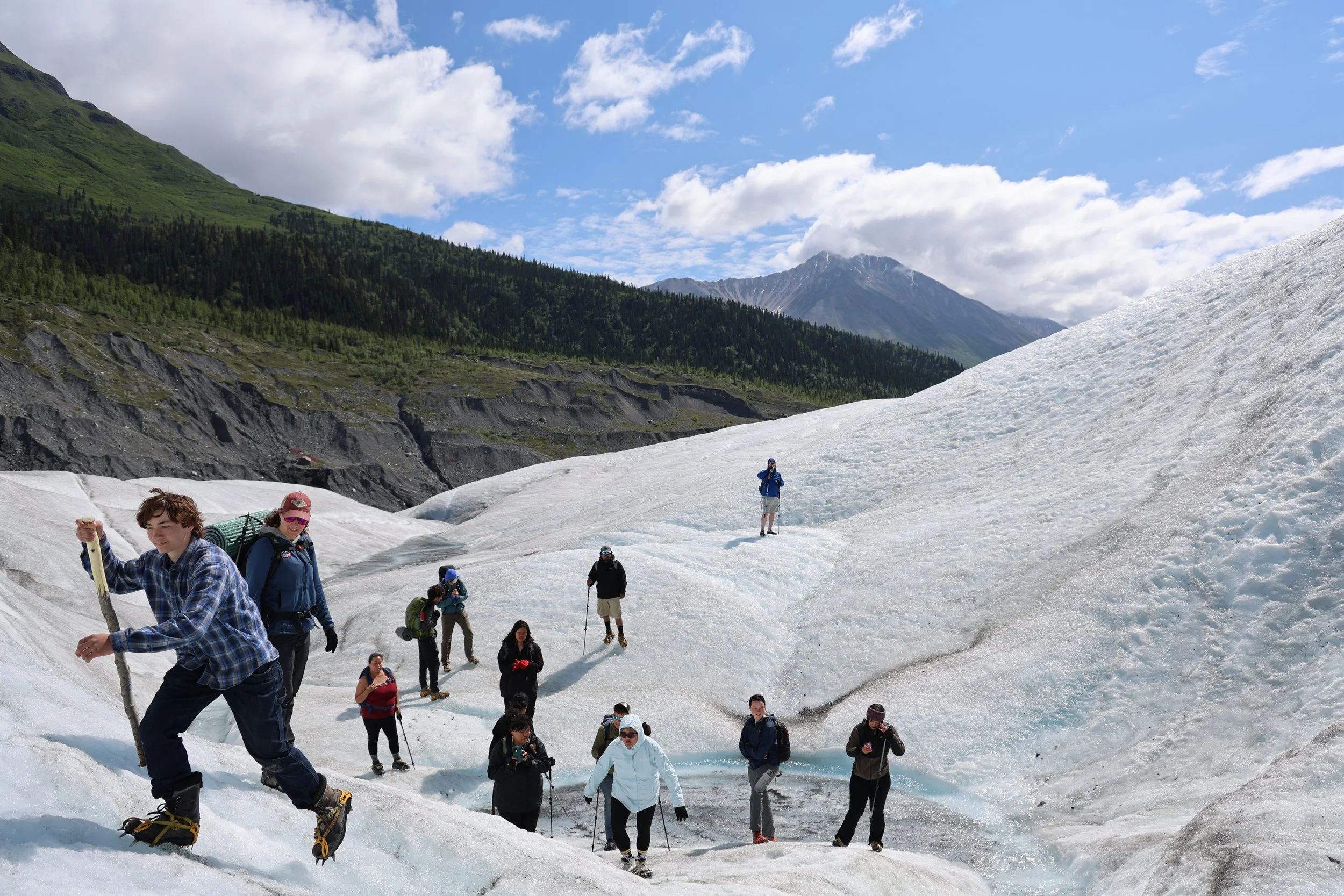
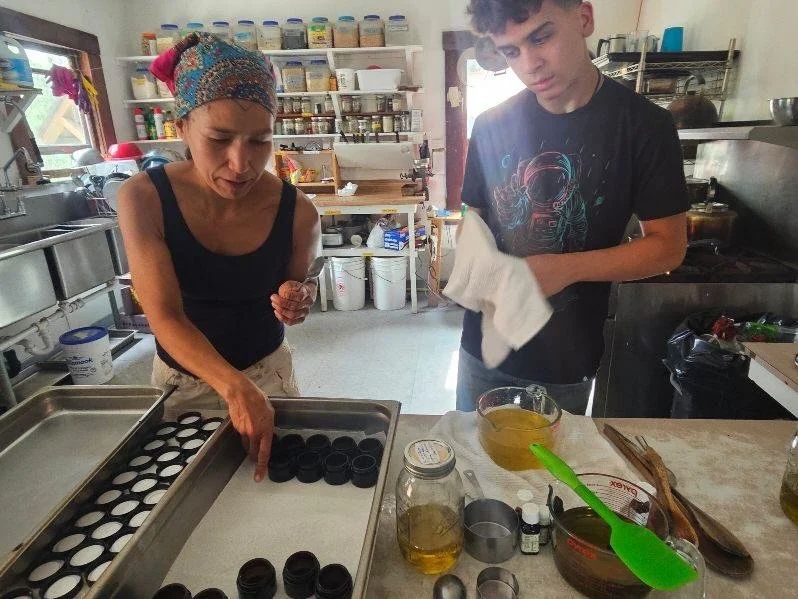
Led by Indigenous Elders and Educators, participants (ages 14-24) will spend 6 nights and 5 full days in the vast and awe-inspiring landscapes of the Wrangell- St.Elias National Park and on the WMC campus, where bunkhouses, gathering areas, and communal kitchen will be our comfortable homebase for this experience. Together throughout the week, students will get to take part in activities and workshops focused on reconnection to heritage, traditional healing practices, place-based relationship, and Ahtna language and history. Bead making, salve making, creating a sweatlodge together, and sharing a potlaatch with the local community are all central parts of this program that we look forward to sharing with you.
Saghani Ggaay was spearheaded by Raven Moonlight and Hereditary Clan Leader, Wilson Justin, and in close collaboration with Copper River Native Association and the Wrangell Mountains Center. The summer of 2025 was the programs pilot year, and our partnership is excited to be offering it again in 2026. To learn more about the camp in 2025, you can read this programming summary put together by Sonia Vent of Raven Moonlight.
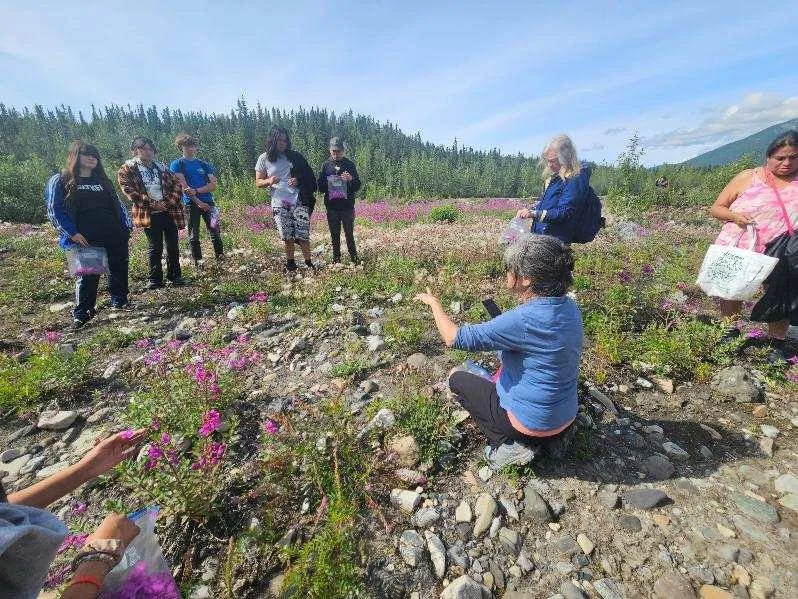
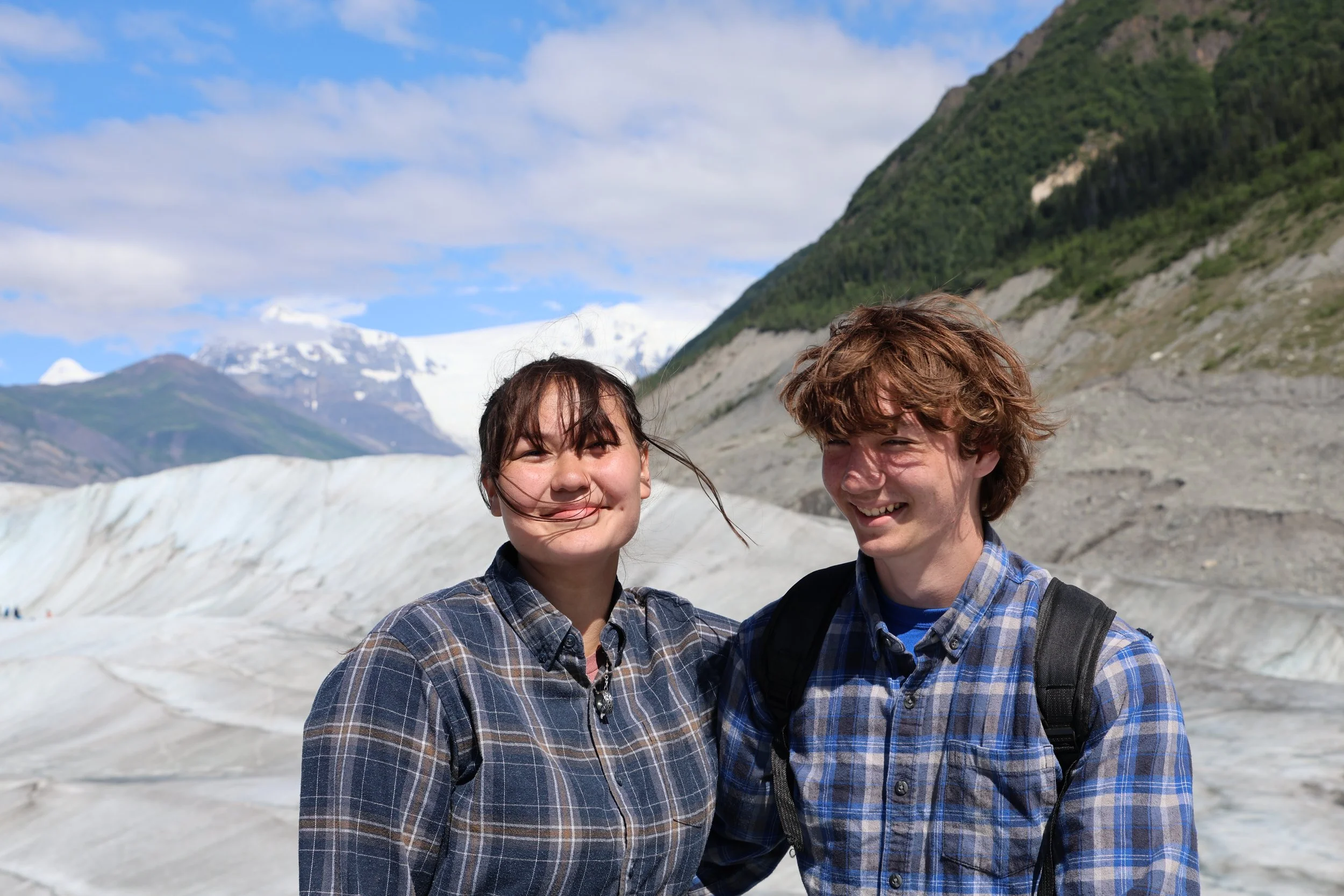
This program would not be possible without partnership and collaboration between the following organizations:
Raven Moonlight is an Alaska Native and women-led nonprofit organization whose mission is to provide culturally appropriate holistic healing, implementing diverse methodology and approach.
Copper River Native Association (CRNA) is a Tribal health organization established in1972 through six compacted Ahtna Villages—Cantwell, Gakona, Gulkana, Kluti-Kaah, Mentasta, and Tazlina. CRNA has a long-standing responsibility to care for the people and lands of the Copper River Basin through culturally grounded services rooted in relationship, respect, and accountability. CRNA has supports youth programming that strengthens cultural identity, leadership development, and intergenerational connection.
The Wrangell Mountains Center (WMC) is a nonprofit organization whose mission is connecting people with wildlands through art, science, and education in Alaska.

Schedule
Details subject to change…

Transportation, Accommodation, and Meals
Student participants will be provided with shuttle transportation to and from Glennallen High School on July 19th and 25th, 2026, all meals while on campus, meetings spaces for talks and workshops, and bunkhouse-style accommodations in our Porphyry Place Cabin and in our 10 X 20 large canvas tent. Please note that our campus is fully off-grid and fairly rustic, so come prepared!
Accommodations include:
Wood Stove in bunkhouse spaces (operated by designated student or chaperone)
Cot with mattress topper or single bed frame with mattress for each participant
Fitted and flat sheet, pillow and pillow case
Outdoor bucket shower (hot water provided)
Outhouses
Large dining hall
Classroom space
Full industrial kitchen for food processing and preparation for potlatch and/or workshops
All meals (all provided except for a sacked lunch on July 19th)
The Setting


The Wrangell Mountains Center operates a rustic campus in the small mountain community of McCarthy, Alaska, on the traditional homelands of the Ahtna people, and adjacent to what is now called Wrangell St.Elias National Park and Preserve. Our facilities include rustic off-grid lodging, kitchen and gathering spaces and will be the setting for Saghani Ggaay
For over 40 years, the Wrangell Mountains Center has safely hosted residential and backcountry educational programs in Wrangell-St. Elias National Park & Preserve. Our staff are Wilderness First Responder-certified, we invest extensively in community collaboration and are committed to our programming created with the vision of people and the land thriving together in a changing world.
What To Bring:
Please remember to pack as light as possible for the ease of transportation and limited space. For your comfort, we suggest that you pack these items:
SLEEPING BAG - Mandatory. The WMC does not provide blankets for beds.
WALKING SHOES or HIKING BOOTS
SOCKS - wool or synthetic (not cotton) socks for use with your hiking boots.
BASE LAYERS - Leggings/tights and base layers for the upper body are very helpful when temps get chilly. July weather is usually warm but still unpredictable!
LONG PANTS - Another form of mosquito repellent!
LONG-SLEEVE SHIRTS - Mosquitoes will bite through thin, single layered tops.
MOSQUITO/BUG HEAD NET - You can either spray your face and neck in bug spray every couple hours or wear a head net when in dense mosquito habitat.
HATS & CAPS
UNDERWEAR - Bring plenty! Students will only be able to hand wash their clothes
RAIN JACKET and RAIN PANTS
WARM COAT - Depending on weather!
SWIMSUIT - There is a swimming hole for students to enjoy, and they will need one for the Steam Bath
TOWEL
HEAD LAMP - We only use natural lighting in many spaces!
ANY GIFTS, CEREMONIAL ITEMS, REGALIA, KEEPSAKES, ETC - If you would like to contribute items to the Potlatch or bring special items to our ceremonial activities
JOURNAL - We encourage self-reflection!
Meet the Team
Wilson Justin
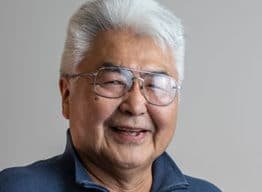
Hereditary clan leader, keeper of sacred stories, ahtna elder
Wilson Justin was born midcentury in Nabesna Alaska, a village later abandoned to comply with the educational requests of the Bureau of Indian Affairs. The family endured a decade of hardships in Chistochina and Mentasta Village but returned to the homelands for the summer months. As an adventurous youngster, Wilson Justin was prone to chase shadows and was on the road by the age of fourteen. Threatened with receivership at the Children’s Home in Fairbanks, he returned to Mentasta Village in 1965 and soon after followed the rest of the family to Anchorage, graduating from West Anchorage High School in 1968.
After high school, Wilson had aspiration of joining the Army but did not pass his physical due to tinnitus. Once the Army was no longer a viable option, Wilson began thinking of what kind of a career could be fashioned for an Athabascan with just a high school diploma. There were no instructions in the sudden transition from a Traditional Society to a one descended from an English speaking world. Wilson had a natural curiosity of the world and soon was able to join the ANCSA Corporation for his region as a Land Planner Trainee in 1977.
Wilson has advised federal agencies such as the United States Environmental Protection Agency (USEPA) on issues around environmental program capacity building. In the early 1990s USEPA began writing the Indian Environmental General Assistance Program statute (IGAP Act of 1992). Wilson played a critical role in the initial structuring of this program and its evolution over the years as a group from just a handful of grants to tribal governments to what it is today with over $27 million in region 10 (Alaska) and over 125 tribes state wide choosing to partner on this program. He has directed IGAP programs including Mount Sanford’s environmental program overseeing the development of a successful regional recycling program. Wilson has professionally attended conferences for decades. He has led numerous discussions on climate change as an acclaimed speaker during interdisciplinary conferences such as the Alaska Forum on the Environment. The publication titled “Alaska Forum on the Environment- Climate Change: Our voices, Sharing our Ways Forward,” became a component of the US Department of the Interior, US Geological Survey, United States National Climate Assessment, Alaska Technical Regional Report (Circular 1379).

Sonia Vent
Saghani ggaay Program Coordinator
Sonia Vent is of Koyukon Athabascan descent from the Interior of Alaska. Her native name is Kedo’ghosleet’, “to survive”.
She practices Traditional Healing and advocates for community wellness. She has formal training as a Physician Assistant and as a Healing Touch Therapist. She has worked with nonprofit organizations promoting the well-being of Alaska Native people and is most recently a co-founder of the nonprofit Raven Moonlight. She is the owner of Sacred Space, a small business. Sonia’s focus is on healing, as the healing of one is the healing of all. Also, she has an interest in sustainability, especially in the Alaska Native subsistence way of life and in the many ways of staying holistically well through hunting, gathering, and growing food. Sonia’s late mother and father were cultural bearers. Sonia hopes to carry their teachings forward through language and traditional Koyukon Athabascan culture.
Sonia was born and raised in the village of Huslia and currently resides in Anchorage. She has one living son and three grandchildren.
Ashley Marion Hicks-Martin

Instructor
Ugheli dzaen (Good day)! My name is Ashley Marion Hicks-Martin. I am the mother of Dez’aiah and wife of James of Kluti-Kaah. My clan is Niisuu. I am originally from Northway but was raised in the Copper River region most of my life. I am Choctaw, and Upper Tanana & Ahtna Athabascan. I graduated from Glennallen High School at the age of 16 and have been attending college on and off for a time. I received 2 Associate degrees at PWSC and I am currently a senior in college pursuing a Bachelor’s of Business Administration and halfway to receiving an Occupational Endorsement in Ahtna Language Certification through the University of Alaska.
My mother is Elaine Sam-Sanford (Theodore Sanford) and my father is the late Joeneal Hicks. My maternal grandparents are Julius Sam and paternal grandparents are Joe & Ruth Hicks. I am the great-granddaughter of Frank & Annie Sam and Fred & Katie John. I work full-time for CRSD as their Migrant Education Coordinator and part-time for ROAR as their Coordinator. I also run a few small businesses from home in Glennallen. My parents taught me from a young age that boredom does not exist and ever since, I have learned to remain on-task and productive. I was raised to live off the land, to subsist, to harvest and to value and protect the land, animals and its resources by my father. My mother taught me how to bead and both taught me to be self-sufficient and not to rely on others. Today, I honor my ancestors by sharing the values that have been passed on to me in an effort to preserve, promote and prevent the loss of language, culture and traditions. For the past year, I have been actively teaching and sharing Native language and traditional beadwork practices with school staff and students in an effort to promote healing and strengthen relationships to each other.
Georgia Jackson
Instuctor
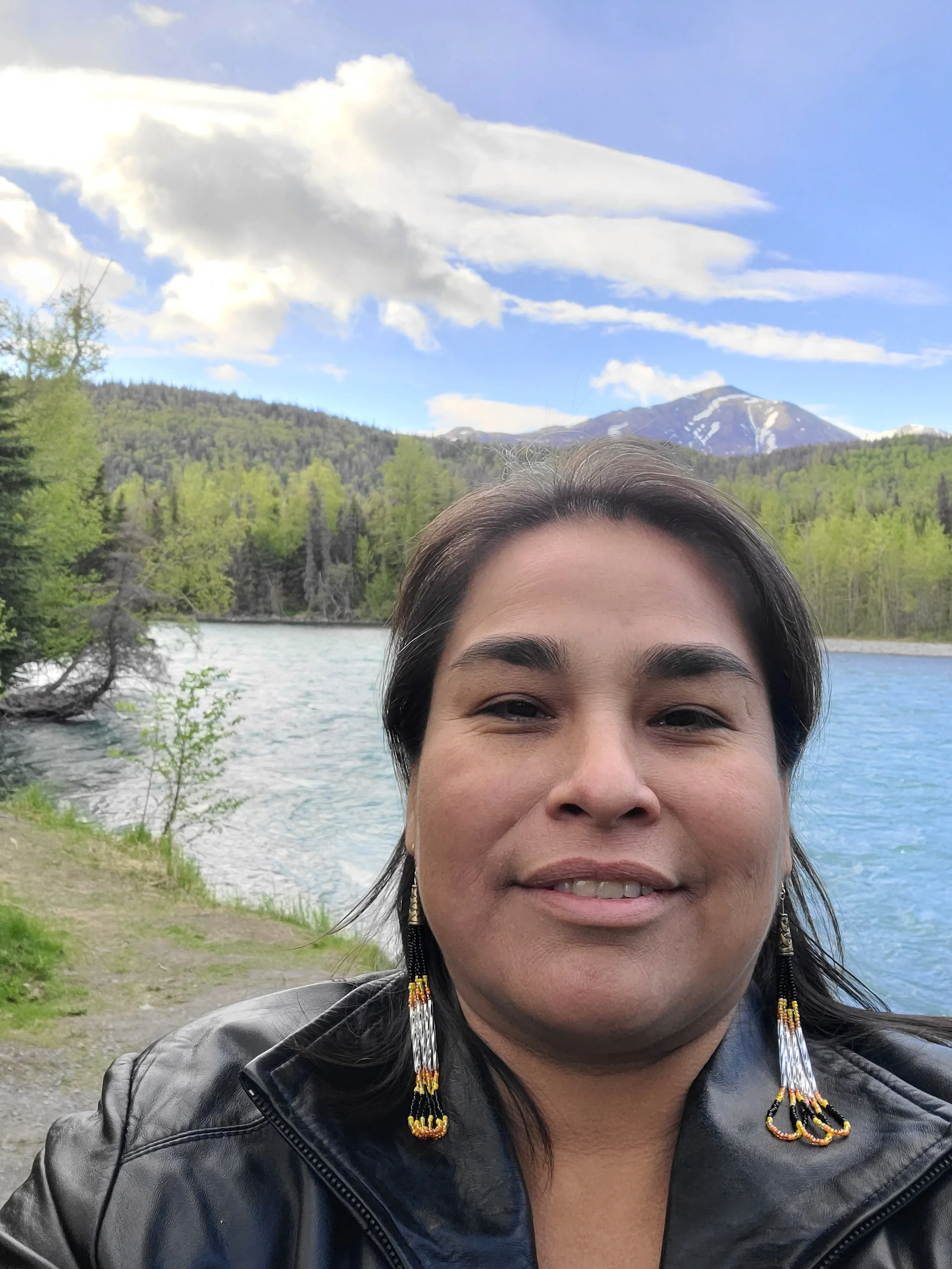
Georgia Jackson is the Indian Education Family and Student Liaison for the Copper River School District. She is a Tl’aticae’e (Native Village of Kluti-Kaah) tribal member, of the Ahtna region in Alaska. Her parents are Clarence and Kathy McConkey, and her grandparents are Clarence McConkey and Marie Craig and Hector and Grace Ewan. She was born and raised, and currently resides in Copper Center, Alaska, and has 6 children, 3 Godchildren, and a grandchild. Georgia was a homemaker and was able to work with her Elders for 13 years. She really values this time of her life to be able to spend time with and learn from so many Elders in the Ahtna region. Georgia strives to teach her children and younger family members about the Ahtna culture whenever she is able. In her current job position she is able to learn more about the Ahtna culture and to turn them into lessons that can be taught in the school.
Heather Beltz
Instuctor
Heather Beltz a Tlingit and Inupiaq Traditional Healer born and raised in Anchorage, Alaska. Originally from the Shangukeidee clan in Klukwan, Alaska and Inupiaq from Nome, Alaska. Dedicated to revitalizing indigenous culture, wisdom and holistic wellness. I learned early in life the importance of health, prayer and herbal remedies. My mission is to carry this ancient medicine to help the body, mind and spirit’s natural ability to heal. I specialize in energy medicine, body work and spiritual counseling.
Wrangell Mountains Center
The Wrangell Mountain Center staff and board supports the vision of Saghani Ggaay and is honored to provide hosting services, coordination and background support to make it possible for this impactful programming to occur on the traditional homelands of the Ahtna people in the McCarthy-Kennicott valley, where our campus exists. Much of the groundwork for this collaborative initiative was laid by our last Director of Operations, Sabrina Simon, who has moved on to her next calling, but put in endless hours over multiple years to help bring the pilot year of Saghani Ggaay, in 2025, into reality. Our current programming staff is committed to continuing to support this work under the Indigenous leadership of our partners.
THANK YOU
Saghani Ggaay would not be possible without the generous support of our funders: Alaska State Council on the Arts, Alaska Mental Health Trust Authority, RurALcap Foundation, the Alaska Community Foundation, and the Copper River School District Migrant Education Program.